13. JULY 2026 THE LAST WORLD CUP IN THREE STRIPES
As the 2026 FIFA World Cup unfolds across Canada, the United States, and Mexico, the German national team is wearing, one last time, something older than the Federal Republic itself: the three stripes on its chest. This is the last World Cup in which the DFB jersey will be made by adidas. Beginning January 1, 2027, Nike will outfit every national team of the German Football Association — the end of a partnership that lasted more than seven decades.
For a foundation devoted to the life's work of Adi and Käthe Dassler, this turning point is worth pausing over: How did this bond grow over the decades — and how could something that was so much more than a supply contract come apart, in the end, over a single number?
A Bond No Contract Created
To understand the end of this partnership, you first have to grasp how unusual its beginning was. It started not with a signature but with a shoe — and with a personal closeness of a kind that today's sponsorship deals no longer know.
The hem of the current DFB jersey reads: "Partner of the German national team since 1954." The year points to the World Cup final in Switzerland, the "Miracle of Bern," the 3–2 victory over the favored Hungarians. Yet the word "partner" scarcely captures what Adi Dassler was that summer. He did not stand beside the team; he belonged to it — as the official kit manager, as much a part of the squad as the eleven players on the pitch. He sat on the bench next to head coach Sepp Herberger, with whom he shared a friendship built up over the years. And when everything hung in the balance on the rain-soaked pitch, it was he who screwed the longer studs into the boots himself at halftime — "Adi, stud up!" became a catchphrase.
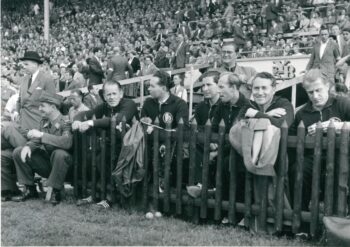
What's striking is what that founding year leaves unsaid: in 1954, there was as yet no jersey partnership. The shirts back then came from the long-since-vanished manufacturer Leuzela; for the 1974 World Cup title, Erima supplied the kit. Only from 1980 onward did adidas outfit the team with jerseys without interruption. The connection thus grew over decades — from the shoe to the personal contact to the complete kit — and precisely because it did not arise from a single deal, it became something that went beyond the commercial: adidas became, in a sense, part of the identity of the German national team.
What Grew Together Over Seven Decades
The record of this partnership can be measured in titles. adidas was the outfitter for all four World Cup titles and all three European Championship titles of the men's team, and likewise for the two World Cup titles and eight European titles of the women's team. Over more than 70 years, a Franconian shoe workshop and a football association became one of the longest and most storied partnerships the international sporting world has known.
That longevity was no foregone conclusion. It was reaffirmed again and again, at times even mediated in arbitration and extended ahead of schedule. Over the decades both sides invoked a relationship meant to be more than a supply arrangement: shared values, youth development, social commitment. The contract that applied most recently ran through the end of 2026 — and, by the stated wish of both parties, was meant to endure well beyond that.
How It Broke Apart
In March 2024, that continuity ended abruptly. The DFB announced that it would switch from adidas to Nike beginning in 2027. What was remarkable was not only the decision itself but the manner of it: by its own account, adidas was caught off guard and informed only after the deal had already been signed. A bond of more than 70 years thus ended not by mutual agreement but as a fait accompli.
Money tipped the scales. The previous contract brought the DFB roughly 50 million euros a year — already the most expensive kit-supplier deal for any sports federation in the world. Nike, according to media reports, is said to be offering about double that, around 100 million euros per year. The DFB, under pressure both on the pitch and financially, openly justified the move on economic grounds; thanks to Nike's commitment, the association said, it could once again look toward "a financially stable future."
And so a bond that had grown over three-quarters of a century dissolves over a number. What had begun as personal closeness between a tinkerer and a national coach, and had become identity over the decades, gives way to the simple logic of the higher bid. For adidas, the loss weighs less in economic terms — the company generates well over 90 percent of its revenue abroad in any case — than in symbolic ones: it is losing the most national of all German sporting symbols, and losing it to precisely the U.S. rival against which it had defined itself for decades as the European counterweight.
What Remains When the Stripes Are Gone
It would be too simple to read the end of the DFB partnership as a defeat for adidas. At this World Cup, the brand with the three stripes still supplies more national jerseys than any other manufacturer. adidas leads the field, followed by Nike and Puma; together the three big brands kit out more than three-quarters of the participating teams. Over the course of the knockout rounds, however, the gap has narrowed — for the first time in a long while, this is no longer a straight two-horse race but an open three-way contest.
And even after 2027, adidas will by no means vanish from football: the brand remains the official ball supplier for the FIFA World Cup — a connection that reaches back to the Telstar of 1970, the first World Cup ball from Herzogenaurach, whose black-and-white pattern made it more visible on the television sets of the day. What adidas keeps, then, is not the advertising-friendly jersey but the technical core product, the ball itself. The shoe and the ball — the craft — always mattered more to Adi Dassler than the symbol.
And yet this consolation should not obscure what is being lost. The value at stake here cannot be manufactured on short notice, nor replaced — it grew over generations: out of Adi Dassler's closeness to the athletes, out of Bern in 1954, out of four World Cup titles under the same three stripes. A jersey thereby becomes a carrier of memory, and it is precisely this layer of history and trust that disappears with the switch, long before the first jersey bearing the new logo is ever sold.
That such a bond should, in the end, give way to the higher bid is understandable from a business standpoint; an association has to manage its finances, and the gap was considerable. But from the perspective of the life's work of Adi and Käthe Dassler, it remains a regrettable affair. For Adi Dassler showed what partnership means in the truest sense: not a logo on the chest in exchange for a sum in the bank, but belonging — one who belonged to the team, not one who supplied it. Every partnership can be measured against that standard, including every future one: does it carry only a name, or does it share a fate?
The last World Cup in three stripes is therefore more than a footnote to sporting history. What a tinkerer and a national coach once founded on a bench in Bern cannot be weighed in the same currency in which it is now being ended — and so this summer is an occasion to remember what this legacy was once made of, and what it would have been worth to preserve it.